Let  be random vectors and let
  denote their tensor product. Assume the vectors
  are isotropic, in the sense that
![\[\expect[x_i^{\vphantom{\top}} x_i^\top] = I.\]](https://www.ethanepperly.com/wp-content/ql-cache/quicklatex.com-5e65b0d7cf66e1cecc4c60470eca40af_l3.png "Rendered by QuickLaTeX.com")
 inherits the isotropy property as well
 ![\expect[xx^\top] = I](https://www.ethanepperly.com/wp-content/ql-cache/quicklatex.com-693de07bc613a6824b8000f4615ccf85_l3.png "Rendered by QuickLaTeX.com") . As a consequence, we can use the vector to form an unbiased estimator for the matrix trace
. As a consequence, we can use the vector to form an unbiased estimator for the matrix trace ![\expect[x^\top Ax] = \tr(A)](https://www.ethanepperly.com/wp-content/ql-cache/quicklatex.com-99c590c818d205b76d1b6ab2b4391edb_l3.png "Rendered by QuickLaTeX.com") . Trace estimation has been a frequent topic on this blog.
. Trace estimation has been a frequent topic on this blog.
What is the variance of the trace estimate  ? This question was addressed by Raphael Meyer and Haim Avron. The variance of the trace estimator
  is
is
![\[\Var(x^\top A x) = \expect[(x^\top A x)^2] - \expect[x^\top A x]^2 = \expect[(x^\top A x)^2] - \tr(A)^2.\]](https://www.ethanepperly.com/wp-content/ql-cache/quicklatex.com-5647f8054d7455519ae8e1bef31af139_l3.png "Rendered by QuickLaTeX.com")
![\expect[(x^\top A x)^2]](https://www.ethanepperly.com/wp-content/ql-cache/quicklatex.com-b5fbf8e67e4ff29170a0eebe078ce961_l3.png "Rendered by QuickLaTeX.com") . Suppose that the individual base vectors satisfy a moment bound
. Suppose that the individual base vectors satisfy a moment bound (1) ![\[\expect[(x_i^\top A x_i)^2] \le \alpha \tr(A)^2 \quad \text{for every psd matrix } A.\]](https://www.ethanepperly.com/wp-content/ql-cache/quicklatex.com-277e90ec9bcf7846732486a3c5953375_l3.png "Rendered by QuickLaTeX.com")
 . Under assumption (1), Meyer and Avron show that the tensor-product trace estimator satisfies the bound
 (2) ![\[\expect[(x^\top A x)^2] \le \alpha^\ell \tr(A)^2 \quad \text{for any psd matrix } A.\]](https://www.ethanepperly.com/wp-content/ql-cache/quicklatex.com-ee2f7f4328d1d2f7117f850c28a62528_l3.png "Rendered by QuickLaTeX.com")
 is positive semidefinite (psd) if it is symmetric and satisfies
  for any vector
  . Observe, the constant in the bound (2) is exponentially larger than the constant in bound (1). Unfortunately, as Meyer and Avron show, this exponentially large variance is a real property of the tensor-structured trace estimator, at least on worst-case examples.
Meyer and Avron’s paper is really nice, and it contains many different results for Kronecker-structured trace estimation beyond the bound (2). I highly recommend checking their paper out, which was just appeared in the SIAM Journal of Matrix Analysis and Applications! In this blog, I’ll give an alternate, somewhat shorter proof of the Meyer–Avron bound (2).
Suppose that  is a tensor product of isotropic vectors
  and
and  , and suppose that
(3) ![\[\expect[(y^\top A_1 y)^2] \le \alpha_1 \tr(A_1)^2 \quad \text{and} \quad \expect[(z^\top A_2 z)^2] \le \alpha_2 \tr(A_2)^2 \]](https://www.ethanepperly.com/wp-content/ql-cache/quicklatex.com-9b8a7bf17b8f16b0ec73e0027423055e_l3.png "Rendered by QuickLaTeX.com")
 and
and  . Now, let be an
  psd matrix, and partition as
 (4) ![\[A = \begin{bmatrix} A_{11} & \cdots & A_{1d_1} \\ \vdots & \ddots & \vdots \\ A_{d_1 1} & \cdots & A_{d_1 d_1} \end{bmatrix}. \]](https://www.ethanepperly.com/wp-content/ql-cache/quicklatex.com-43bb38960318d2dc04d04e021243f074_l3.png "Rendered by QuickLaTeX.com")
(1) 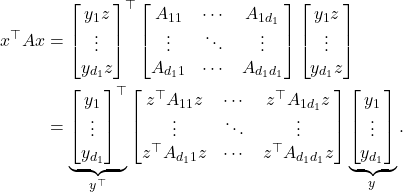
 alone and applying (3), we obtain
 (2) ![\begin{align*}\expect_y [(x^\top A x)^2] &\le \alpha_1 \left( \tr \begin{bmatrix} z^\top A_{11}z & \cdots & z^\top A_{1d_1}z \\ \vdots & \ddots & \vdots \\ z^\top A_{d_1 1}z & \cdots & z^\top A_{d_1 d_1}z \end{bmatrix} \right)^2 \\ &= \alpha_1 [z^\top(A_{11}+\cdots+ A_{d_1d_1})z]^2.\end{align*}](https://www.ethanepperly.com/wp-content/ql-cache/quicklatex.com-4536f123e88a9b329362cc19825464cc_l3.png "Rendered by QuickLaTeX.com")
 and invoking the law of total expectation then yields
 (3) ![\begin{align*}\expect [(x^\top A x)^2] &\le \alpha_1 \alpha_2 \tr(A_{11}+\cdots+ A_{d_1d_1})^2=\alpha_1 \alpha_2\tr(A)^2.\end{align*}](https://www.ethanepperly.com/wp-content/ql-cache/quicklatex.com-5f49a9eb10fd37e189a8f518add54828_l3.png "Rendered by QuickLaTeX.com")
is the sum of the traces of its diagonal blocks  . Voilà! We have deduced the bound
 ![\[\expect [(x^\top A x)^2] \le \alpha_1\alpha_2 \tr(A)^2,\]](https://www.ethanepperly.com/wp-content/ql-cache/quicklatex.com-434b9be6486b07cf1509bbe664e7f3d4_l3.png "Rendered by QuickLaTeX.com")